|
In this issue... |
|
 , ,
Our newsletter is once again filled with a lot of information to help you get that PMP behind your name.
First, you can read part two of my article on the 10 Steps To Becoming A PMP. I know this will help you a great deal in preparing for the PMP Exam.
Second, we have a new section in our newsletter, the Recommended Study Material where we are featuring the book by Diane Altwies Achieve PMP Exam Success, 4th Edition. Indeed a great study guide for the PMP Exam.
Of course last but not the least, we have our usual dose of PMP exam tips, sample questions and lessons learned from PMP exam passers.
Continue reading and Enjoy!!
Until Next Time,
Cornelius Fichtner, PMP
President, OSP International LLC
|
Recommended Study Materials
|
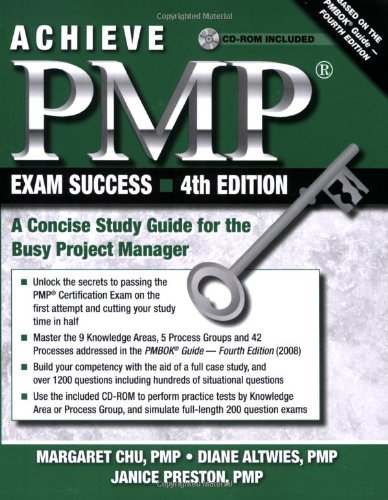 Achieve PMP Exam Success Achieve PMP Exam Success
by Diane Altwies, 4th Edition
A Great Study Guide For the PMP Exam
This book comes highly recommended because it was the book Cornelius Fichtner, PMP (the president of our company) used when preparing for his own PMP exam.
Full Disclosure: "Achieve PMP Exam Success" is an affiliate product. If you click & choose to purchase the book, we will earn a commission.
The material contained within the PMBOK Guide heavily influences the PMP exam. Unfortunately, many people studying for their exam find the PMBOK Guide to be difficult to read. Many students have been intimidated by the sample exam questions because they weren't able to fully comprehend the material within the guide.
Fortunately, there are many study guides available to help with this. A good study guide doesn't just present the material, it puts an equal amount of focus on helping you to understand the material.
"Achieve PMP Exam Success" is one of the best study guides available when preparing for the PMP exam.
The first chapter of the book focuses on information that is most important to those who are studying for the exam - what is the exam like. This chapter will review what to expect from the exam as well as the best strategies to use when studying and preparing for the exam. This is especially helpful for people who have not attended college courses in recent years. Those who may have forgotten how to study or how to take a multiple choice exam will find the proven study techniques that are discussed very helpful.
The remainder of the book is structured like the PMBOK Guide. There are chapters on project management framework, project management processes as well as a chapter on each of the nine knowledge areas. The final chapter focuses on professional responsibility.
Each chapter in the book contains sample questions as well as case studies that replicate real life situations a PM is faced with. These exercises allow you to transfer the knowledge you have gained to practical examples and ensures a deeper level of understanding.
There is a post-assessment exam at the end of the book and the CD that is included contains more than 1,200 sample questions. If you want the best chance to pass your PMP exam, this is the book that will help you!
Order "Achieve PMP Exam Success" from Amazon by clicking on the link:
http://www.project-management-prepcast.com/success
(Disclosure: Compensated Affiliate)
|
|
10 Steps To Becoming A PMP: Part 2 |
|
Last week we gave you steps 1 to 5, now here are steps 6 to 10 to becoming a PM..
Step 6: Listen to a PMP Audio Workshop or Read a PMP Preparation Book.
There are many very good PMP Audio Workshops and PMP Preparation Books available. You can find them on eBay, Amazon or in your local bookstore. These resources will teach you the 25% of additional material that you cannot find in the PMBOK Guide. And because the PMBOK Guide is so "dry", these third party products will help you understand what the PMBOK Guide is trying to say. They will "translate" the concepts, tools and techniques from the Guide and give you examples from everyday PM life to show you what is meant.
Many of the audio courses also come with contact hours - the books cannot offer that benefit.
Step 7: Take an In-Person PMP Workshop.
PMI chapters, universities, colleges and training companies offer a number of in-person PMP workshops around the world. They usually last from 2-6 days. Some of them require that you study for yourself in addition to the course and others don't. Some companies even offer a passing guarantee. But don't be fooled. This guarantee is just marketing and their risk is very low. After all - would you intentionally fail the exam, just so that you can take their course again?
In any case, taking an in-person course combined with your own studies is probably the best way to go. If you are lucky, then your employer may offer to pay for such a course. If you have to pay for it yourself, then look into the course that is offered by your local PMI chapter because they are usually very affordable.
Just like the audio courses and books, the classroom training will help you understand the PMBOK Guide. The benefit here is that you will have an instructor and other students to help you understand particularly difficult sections like earned value or risk from the PMBOK Guide. Don't be shy to ask questions.
Step 8: Answer as many Sample Questions as you can.
You get what you pay for. Free is good to get an idea, but you will have to pay for "real" questions in a book, as a CD or online. The benefit of buying a book is that you can go down to your local bookshop and take some time to look through the questions in the books before you decide which one to buy. The benefit of buying your sample tests as a CD or online is that they usually come in some form of an exam simulation. That way you can get used to answering your questions on the computer. We offer links to over 30 free and commercial sample tests in the PMP resources section of our website at http://www.project-management-prepcast.com.
As you make your way through all the free samples that you find online two things will happen: First you will get used to answering exam questions, which is good. And second you will begin to disagree with some of the suggested answers, which is even better. By disagreeing and then opening up your study materials to review you will learn even more. Therefore, even the worst exam sample question that you can find can teach you how to pass the exam. It's all a matter of your personal attitude and knowing that even a bad question can take you further.
Also important: Keep track of your score. As time goes by, you will notice that you are more and more able to answer questions correctly. If you keep your score, then you can see where you are. Here is rule of thumb for you: if you consistently answer 85% of the questions correctly, then you are ready to take the exam.
Step 9: Study Hard and have a Plan.
Studying for the PMP exam is a serious endeavor and requires personal dedication. Manage your road to becoming a PMP like a project and create a plan - a study plan. In this plan, define how many hours you will study every day, how many chapters you will read and how many sample questions you will answer. Having a good plan is the start. Then you will also have to tell your family and friends about it. That way they know that you will be "gone" for the next 2-3 months to prepare. But don't overdo it.
You should plan on having breaks and leisure time as well. You need variety in your life, so don't forget to go and see a movie every now and then or have a drink with your friends.
During your studies, be prepared for ups and downs. Some sections of the PMBOK Guide are easy for you and you feel great. But then, there are those sections that are more difficult because you don't have any experience. Don't despair. Don't think that you are never going to understand this. Thousands of people have passed the exam before you and you can pass it, too! Stay positive at all times.
Recommended resource: The PMP PMBOK Guide StudyCoach. (Disclosure: I created this product.)
Step 10: Take the Exam.
After all that hard work, taking the exam almost sounds like the easy part. But there are a few things to consider that will help you to make this a good and successful experience for you.
Try and get a good night's sleep the night before the exam. Being refreshed and having slept enough is important. There is no need for you to study the night before the exam and stay up until 3am. You have studied long and hard and you are now ready for this. So sleep.
A lot of people choose to take the day of the actual exam off. You can sleep in, eat a good breakfast, go for a walk and relax. That way you will not be too nervous when you get to the testing center. It is of course also a good idea to drive to the testing center a week before, so that you know where it is and you may also want to try and arrive 1 hour early. Just in case that you miss the bus or your car has problems.
Here is what you should bring: Two forms of official identification with a photo; Water and some snacks; A sweater or light jacket; A simple calculator; Earplugs because it could be noisy.
Before the exam starts there is a short tutorial that explains how to use the computer and software. Don't skip it. There is important information in the tutorial. If you take the tutorial, then you can be sure that you understand everything and don't make any mistakes because you made assumptions.
Now click the "Start Exam" button. Good luck!
|
|
| Expect the Unexpected during Your PMP Exam |
|
 Prepare yourself and expect the unexpected to happen during the PMP Exam. Prepare yourself and expect the unexpected to happen during the PMP Exam.
Watch this video we have prepared for you: http://bit.ly/frT5Tb
|
|
Sample PMP Exam Question
|
 You are managing a construction project. You have just been intimated that it is likely to rain heavily during the next week. This can delay your project by a week and you will miss a deadline. This risk will cost you a potential impact of $50,000 if it happens. The probability of the occurrence of this risk is 75%. What is the expected value for this risk? You are managing a construction project. You have just been intimated that it is likely to rain heavily during the next week. This can delay your project by a week and you will miss a deadline. This risk will cost you a potential impact of $50,000 if it happens. The probability of the occurrence of this risk is 75%. What is the expected value for this risk?
A. 37500
B. -37500
C. 50000
D. -50000
Hint: Calculate the expected value by EMV formula. Also note that threats are treated as negative numbers.
|
|
|
Exam Tip: Always use the PMBOK Guides's approach when answering PMP Exam sample questions |
There is a bit of a disconnect that PMP Exam takers report as they are preparing for the exam. Because you must be an experienced project manager to take the exam, you bring years of experience in managing projects and using tools & techniques with you. Often, these are based on company internal project management best practices and tactics that you found working for you. However, the PMP Exam requires that you apply the concepts from the PMBOK Guide to real-life situations as presented in the exam questions. If the methodology that you are experienced in using is not aligned with the PMBOK Guide, then you may pick the wrong answers in your test.
Furthermore, the projects you manage may not have required you to deal in all the PMBOK Guide's Knowledge Areas. For instance, risk management was something I did very rarely on my projects and maybe in your career you never had to deal with procurement. So it is likely that you'll be more comfortable with some project management knowledge areas and processes than others. This can lead to two problems:
First you may feel that because you are an absolute pro in scheduling (after all you have years of experience here) you can slack off in your studies and rely on your own project management experience instead. You tend to minimize studying for the areas you know best. But this can hurt you because the PMBOK's approach is the correct approach for the PMP exam.
The second is the tendency to minimize the importance of project management areas with which you are unfamiliar. Just because I didn't do much risk management doesn't mean that it isn't important. But we are creatures of habit, so it's only normal to also think that the "unimportant" areas on our projects are also "unimportant" on the exam. PMPs are expected to demonstrate a good understanding of all aspects of project management as defined in the PMBOK. So pay particular attention to the processes with which you are not familiar.
So what's the best approach? I always recommend to my students that they study the PMBOK Guide at least twice before taking the exam and that they immediately start using the practices learned on their projects. Applying the theory from the PMBOK Guide on your projects is the best way of learning it and passing the exam.
|
|
Solution
|
|

The correct answer is: B
Reference: PMBOK4 - pg:298
Explanation: EMV for a risk is calculated by multiplying the value of its impact by its probability of occurrence. This will result in 75% * -$50,000 = -$37,500. Choice D is the correct answer to this question.
|
|
Lessons Learned from Prabhakar Rathinam
|
Dear All,
I am very glad as I am PMP. I cleared the test in first attempt on 17-Dec-2010.
I want to share my experience here with you all which may make the path easier to succeed.
First I decided to buy Cornelius's PM Prepcast only for 35 Hours contact hours certificate. But when I listened the subjects, I decided to use as primary resource for preparing for the exam.
I used Head first PMP also for Preparation, it is great book who doesn't like to read more but to capture the concept. Particularly for more theoretical areas like procurement, Human Resources and communication management I referred both The PM Prepcast & Head first PMP.
I read PMBOK 4th edition only once fully. Particularly the glossary is very important and it will make us comfortable if we read this just a day before or on the day of exam.
It took two months to prepare and to become comfortable to face the exam. On previous night of the exam day I was not sleeping well and afraid much.
But during exam I was enjoying and didn't take any break in between. 4 hours went just like half-an-hour. Thanks to Cornelius who played major role to become eligible for the exam (35 contact hours) and to make easy to understand the PM concepts during walking, travelling and even during shopping .
Best way to succeed is to be more positive during the preparation. Referring limited resources (Max three)with fixed duration (Max three to four months). Understanding the core concepts instead of just memorising.
Thanks to Cornelius once again and Best wishes to PMP aspirants.
Read more success stories here..
|
|
|
|
