|
In this issue... |
|
 , ,
The success stories I have heard from PMP Exam passers has been inspiring that is why my team and I continuously offer quality information, tips and advice to you, who has been aspiring to get that most-sought after PMP behind your name.
This is our second week to give you my recommended study material because I strongly believe this will help you further prepare for the PMP exams. This week we are featuring Rita Mulcahy's best selling book - PMP Exam Prep 6th Edition.
I am also happy to announce that we are partnering with gantthead to promote the PMXPO 2011. This is pretty much the largest virtual project management conference and exhibition in the world and it takes place on May 19th 2011 right on your computer. Here is more info about it:
gantthead is once again excited to be bringing you our annual virtual conference and exhibition on May 19th. Learn, network, earn PDUs and gain valuable knowledge from the comfort of your home, office or somewhere in between. Registration is free.
In this week's article read my advice on why you should Break Your PMP Studies Into Pieces. Read on and enjoy!
Until Next Time,
Cornelius Fichtner, PMP
President, OSP International LLC
|
Recommended Study Materials
|
PMP Study Guide Book:
PMP Exam Prep 6th Edition by Rita Mulcahy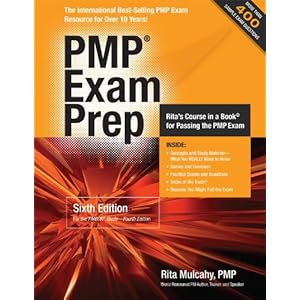
Rita's Course in a Book for Passing the PMP Exam
We recommend this book because this is the best selling (and most popular) book on the market to help you prepare for The PMP Exam.
Full Disclosure: "PMP Exam Prep 6th Edition" is an affiliate product. If you click and choose to purchase the book, we will earn a commission.
This book will help you prepare for the PMP exam and was made possible by long hours of research, interviews with project managers who failed the exam to fill the gap of knowledge, and a razor sharp focus to ensure that project managers don't waste time in studying lessons which are less important.
PMP Exam Prep, Sixth Edition by Rita Mulcahy contains hundreds of updates and improvements from previous editions--including new exercises and sample questions which was never been printed. It has hundreds of test questions, critical time saving tips and activities that are not available in any other PMP Exam Prep books. It should help you pass the exam on your first try.
The first 3 chapters of this book talk about materials and Project Management framework. It discusses critical chain management and important methodologies involves. In the chapters 4-12 it reviews the 9 knowledge areas of Project Management and thoroughly explains their value. In chapter it 13 discusses Professional and Social responsibility of a project manager.
This book also has very important study tips (critical time saving time), eligibility checklist, common errors and pitfalls tips, games and exercises. These things will help you improve your study skills and absorb more important knowledge about Project Management.
This book also includes a database of 1,500 questions in a CD. Together with many sample exercises, you will have plenty of sample test to take to ensure that you'll be prepared and pass the PMP exam.
Order "PMP Exam Prep 6th Edition" from Amazon by clicking on the link: http://www.project-management-prepcast.com/mulcahy.html
(Disclosure: Compensated Affiliate)
|
Break Your PMP Studies Into Small Pieces
|
 Taking the PMP examination is one of the biggest steps you'll take in your career as a Project Manager and one of the most daunting. There seems to be an endless parade of information to stuff into your brain but don't be discouraged! By careful planning and structure, you can pass the exam with a minimum of stress and absorb more of the information you need to be a success in your chosen career. Taking the PMP examination is one of the biggest steps you'll take in your career as a Project Manager and one of the most daunting. There seems to be an endless parade of information to stuff into your brain but don't be discouraged! By careful planning and structure, you can pass the exam with a minimum of stress and absorb more of the information you need to be a success in your chosen career.
The very first thing you need is a study plan. Assess your daily obligations; many people devote months to their studies and ignore the other things they need to do every day. Distraction sets in; catch-up becomes tedious and interferes with studies. List your normal schedule and then assign a daily time for study, usually 90-120 minutes. By establishing a routine, you have study time allotted and everything else that can distract you has already been taken care of.
Why assign a time limit for study? There are only so many hoops you can make your brain jump through before it tires and begins to stumble. Just like pushing yourself physically, after awhile pushing yourself mentally becomes redundant and you start to lose the progress you've made. By limiting your study time, you actually increase your retention and the amount of knowledge you can absorb! If your goal is to be the best Project Manager you can be this may be one of the most important things you can do for your future. You'll only need sixty one percent to pass the exam but if you want to enjoy being the very best at what you've chosen to do, aim a lot higher.
Setting weekly goals and keeping track of your progress will not only encourage you as you study, you'll be able to make the most of your time and study more effectively. Instead of skipping around and perhaps missing an important area of study, you'll cover everything thoroughly. It would be a good idea before you begin to make a chart of your objectives, week by week. This will help you to focus on daily goals but be sure not to cram too much into each session. You will retain much more by concentrating on one subject at a time. Since you need to learn so many things about so many subjects, it may be best to divide the subjects into categories that make sense to you. If there is something of particular interest to you that you really enjoy, you might place it in such a way that it "rewards" you after an especially difficult section of study.
Repetition is another good technique for solidifying your new knowledge. Believe it or not, repeating a fact to yourself creates a neural pathway that your memory can travel again. Rather than "burning" it into your memory, you're clearing a trail through the undergrowth with the important knowledge at the end of the path. By repeating something to yourself or writing it on paper, you're walking it home where it will stay as long as you visit it occasionally. It's best to practice repetition every day for at least a month and ideally for two months. If possible, you should do your repetitive mental calisthenics when you first get up, as the brain is at its most receptive immediately upon awakening. Plus, relaxing in bed for ten minutes while you mentally repeat what you want to remember can be very pleasant and reinforce a positive outlook toward your PMP test!
If you are planning on taking an in-person PMP prep class, then you should be aware that much of the training will be following the structure and content of the PMBOK. By reading through and highlighting the most important passages, you can prepare yourself quite well for the class and use the class to ask specific questions about hard to grasp topics. So make your plan, establish a routine, break your learning into small chunks and reinforce your learning through repetition.
A very important last suggestion--everyone needs a break. Even if you're enjoying your studies, you should take at least one full day a week to get completely away from it and do other things. It doesn't have to be a big production or cost a lot of money; a morning walk, reading, a movie, a play, or anything that truly relaxes and refreshes you is just as important as the work you do the rest of the week.
|
|
|
Take a PMP Exam Prep Class
|
|
 One best way to prepare for your PMP Exam Certification is to take an in-classroom prep course. One best way to prepare for your PMP Exam Certification is to take an in-classroom prep course.
Watch this video we have prepared for you: http://bit.ly/e11Guq
|
|
Sample PMP Exam Question
|
A risk has a potential impact of $50,000 if it happens. The probability of the occurrence of this risk is 50%. What is the expected value for this risk?
A. 100000
B. 75000
C. -50000
D. -25000
Hint: Calculate the expected value by EMV formula. Also note that threats are treated as negative numbers.
|
|
Exam Tip: Answer at least 1,000 Sample Questions
|
 One of the important aspects of preparing for your PMP Certification is going through a process of answering a series of sample questions that are purposely meant to test your readiness for the big day. As you may already have realized, studying for the exam requires a lot of work, including taking numerous sample tests to find out if you can cope with the question format of the actual exam. One of the important aspects of preparing for your PMP Certification is going through a process of answering a series of sample questions that are purposely meant to test your readiness for the big day. As you may already have realized, studying for the exam requires a lot of work, including taking numerous sample tests to find out if you can cope with the question format of the actual exam.
This is why we recommend that you take at least 1,000 PMP sample questions. This means that you simulate a complete 4 hours exam to gauge your ability to finish the actual exam on time. As a general rule of thumb: If you are able to correctly answer at least 85% or more of the practice questions on your first try, then you are ready for the PMP Certification Exam.
It is important that you take these sample exams as they prepare you for the rigors of the exam day, and the type of questions that will be asked. It is even possible that you will encounter questions similar to the ones on your sample tests during the actual exam.
Remember that PMI does not release the actual number of questions that you need to answer correctly in order to pass. They are very vague about it and you can read up on the exact scoring system in the PMP Handbook. The best that you can do is to take a shot at practicing with sample exams. That helps you to get prepared.
|
|
Solution
|
|

The correct answer is: D
Reference: PMBOK4 - pg:298
Explanation: EMV for a risk is calculated by multiplying the value of its impact by its probability of occurrence. This will result in -$25,000. Choice D is the correct answer to this question.
|
|
|
Lessons Learned from Dung Le |
|
Passed PMP on the very first time...
I made it on Mar 31...!
Preparation:
I studied by myself for almost 4 months - 8 hours per week. I scanned through PMBOK and Rita book around twice and listen to PM Prepcast several times on way to work everyday. It was really helpful - Thanks Cornelius.
I entered testing phase the last month of my study: went through some free test on PM Study, simplilearn, etc...I didn't try any commercial test.
About a week before the exam, I did brain dump sheet and Rita process chart every morning about 15 minutes.
I took 2 days off work before exam just for relaxing...not study at all.
I didn't try to memorize anything except formulas throughout my study, instead I tried to learn and understand concepts, and see how that is applied in my real world project management. This is crucial.
Exam Day:
I finished my brain dump sheet during the first 15 minutes of tutorial, then start the exam. I didn't feel nervous. I took break every 50 questions.
The questions were really qualified questions. I didn't find any questions familiar to those I did in sample test. All situational questions were really challenge which made me think deeply for answer. I would have never been able to answer these question if I didn't study by understanding concepts and real world project management during my study!!!
I finished questions and reviewed marked one in 3.5 hours, took 10 minutes break, then clicked "End" button. After the computer was running for a while, I was too happy when seeing "Congratulations" word appearing on the screen.
My hard self-study got great return...
Something to share and good luck to those in coming PMP exams.
Again, thank you Cornelius for very useful PMP material.
All the best,
Dung
To see more testimonials from PMP exam passers, click here..
|
|
|
|