|
In this issue... |
|
 Hello , Hello ,
The success stories I have heard from PMP Exam passers has been inspiring that is why my team and I continuously offer quality information, tips and advice to you, who has been aspiring to get that most-sought after PMP behind your name.
As another brilliant way to help you pass the PMP exams, we are offering great discounts and deals from our line up of PM
products starting this month. Each month, a featured product will be offered at a
discounted price in the form of coupon codes giving you the best value
out of your money. So start looking out and start saving! Read on and learn more!
Until Next Time,
Cornelius Fichtner, PMP
President, OSP International LLC
|
| Monthly Discount Coupon Program |
|
Great deals are coming your way starting this November as we are offering great discounts and deals from our line up of PM products. Each month, a featured product will be offered at a discounted price in the form of coupon codes giving you the best value out of your money. So start looking out and start saving!
As an introductory deal, we are offering you the PM Prepcast at 15% off from it's original price of $99.97 starting November 1 - 30, 2011. This allows you to save up to $15 which you can use on a rainy day. See summary of details below:
November 2011 Discount Coupon
| Product: |
The PM PrepCast |
| Regular price: |
$99.97 |
| Discount: |
$15/ 15%
|
| Price after discount: |
$84.97 |
| Coupon validity: |
November 1 - 30, 2011 |
| Coupon code: |
Nov11 |
Redeeming this great deal is easy! First watch this video here http://www.youtube.com/watch?v=8tG81gp6AuQ to learn how to use the coupon and then go to our website at www.pm-prepcast.com where you begin by clicking on "Order" at the top. (Please note that our coupons are only available for new purchases and cannot be applied as a refund if you purchased earlier.)
Sign up for our free newsletter to get the latest coupon codes, amazing deals and promos for our featured products each month! Our coupon codes can also be seen from our site so look out for it and don't let the opportunity pass you. Order now as this is only a one time limited offer that you cannot get anywhere else!
|
Recommended Study Materials
|
PMP Study Guide Book:
PMP Exam Prep 6th Edition by Rita Mulcahy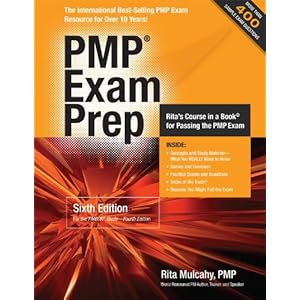
Rita's Course in a Book for Passing the PMP Exam
We recommend this book because this is the best selling (and most popular) book on the market to help you prepare for The PMP Exam.
Full Disclosure: "PMP Exam Prep 6th Edition" is an affiliate product. If you click and choose to purchase the book, we will earn a commission.
This book will help you prepare for the PMP exam and was made possible by long hours of research, interviews with project managers who failed the exam to fill the gap of knowledge, and a razor sharp focus to ensure that project managers don't waste time in studying lessons which are less important.
PMP Exam Prep, Sixth Edition by Rita Mulcahy contains hundreds of updates and improvements from previous editions--including new exercises and sample questions which was never been printed. It has hundreds of test questions, critical time saving tips and activities that are not available in any other PMP Exam Prep books. It should help you pass the exam on your first try.
The first 3 chapters of this book talk about materials and Project Management framework. It discusses critical chain management and important methodologies involves. In the chapters 4-12 it reviews the 9 knowledge areas of Project Management and thoroughly explains their value. In chapter it 13 discusses Professional and Social responsibility of a project manager.
This book also has very important study tips (critical time saving time), eligibility checklist, common errors and pitfalls tips, games and exercises. These things will help you improve your study skills and absorb more important knowledge about Project Management.
This book also includes a database of 1,500 questions in a CD. Together with many sample exercises, you will have plenty of sample test to take to ensure that you'll be prepared and pass the PMP exam.
Order "PMP Exam Prep 6th Edition" from Amazon by clicking on the link: http://www.project-management-prepcast.com/mulcahy.html
(Disclosure: Compensated Affiliate)
|
Break Your PMP Studies Into Small Pieces
|
 Taking the PMP examination is one of the biggest steps you'll take in your career as a Project Manager and one of the most daunting. There seems to be an endless parade of information to stuff into your brain but don't be discouraged! By careful planning and structure, you can pass the exam with a minimum of stress and absorb more of the information you need to be a success in your chosen career. Taking the PMP examination is one of the biggest steps you'll take in your career as a Project Manager and one of the most daunting. There seems to be an endless parade of information to stuff into your brain but don't be discouraged! By careful planning and structure, you can pass the exam with a minimum of stress and absorb more of the information you need to be a success in your chosen career.
The very first thing you need is a study plan. Assess your daily obligations; many people devote months to their studies and ignore the other things they need to do every day. Distraction sets in; catch-up becomes tedious and interferes with studies. List your normal schedule and then assign a daily time for study, usually 90-120 minutes. By establishing a routine, you have study time allotted and everything else that can distract you has already been taken care of.
Why assign a time limit for study? There are only so many hoops you can make your brain jump through before it tires and begins to stumble. Just like pushing yourself physically, after awhile pushing yourself mentally becomes redundant and you start to lose the progress you've made. By limiting your study time, you actually increase your retention and the amount of knowledge you can absorb! If your goal is to be the best Project Manager you can be this may be one of the most important things you can do for your future. You'll only need sixty one percent to pass the exam but if you want to enjoy being the very best at what you've chosen to do, aim a lot higher.
Setting weekly goals and keeping track of your progress will not only encourage you as you study, you'll be able to make the most of your time and study more effectively. Instead of skipping around and perhaps missing an important area of study, you'll cover everything thoroughly. It would be a good idea before you begin to make a chart of your objectives, week by week. This will help you to focus on daily goals but be sure not to cram too much into each session. You will retain much more by concentrating on one subject at a time. Since you need to learn so many things about so many subjects, it may be best to divide the subjects into categories that make sense to you. If there is something of particular interest to you that you really enjoy, you might place it in such a way that it "rewards" you after an especially difficult section of study.
Repetition is another good technique for solidifying your new knowledge. Believe it or not, repeating a fact to yourself creates a neural pathway that your memory can travel again. Rather than "burning" it into your memory, you're clearing a trail through the undergrowth with the important knowledge at the end of the path. By repeating something to yourself or writing it on paper, you're walking it home where it will stay as long as you visit it occasionally. It's best to practice repetition every day for at least a month and ideally for two months. If possible, you should do your repetitive mental calisthenics when you first get up, as the brain is at its most receptive immediately upon awakening. Plus, relaxing in bed for ten minutes while you mentally repeat what you want to remember can be very pleasant and reinforce a positive outlook toward your PMP test!
If you are planning on taking an in-person PMP prep class, then you should be aware that much of the training will be following the structure and content of the PMBOK. By reading through and highlighting the most important passages, you can prepare yourself quite well for the class and use the class to ask specific questions about hard to grasp topics. So make your plan, establish a routine, break your learning into small chunks and reinforce your learning through repetition.
A very important last suggestion--everyone needs a break. Even if you're enjoying your studies, you should take at least one full day a week to get completely away from it and do other things. It doesn't have to be a big production or cost a lot of money; a morning walk, reading, a movie, a play, or anything that truly relaxes and refreshes you is just as important as the work you do the rest of the week.
|
|
|
Take a PMP Exam Prep Class
|
|
 One best way to prepare for your PMP Exam Certification is to take an in-classroom prep course. One best way to prepare for your PMP Exam Certification is to take an in-classroom prep course.
Watch this video we have prepared for you: http://bit.ly/e11Guq
|
|
Sample PMP Exam Question
|
A risk has a potential impact of $50,000 if it happens. The probability of the occurrence of this risk is 50%. What is the expected value for this risk?
A. 100000
B. 75000
C. -50000
D. -25000
Hint: Calculate the expected value by EMV formula. Also note that threats are treated as negative numbers.
|
|
Exam Tip: What is the difference between Quality Assurance and Quality Control?
|
Many people have trouble understanding the difference between Quality Assurance (QA) and Quality Control (QC) as they are preparing for their PMP Exam. That is not surprising. The terms are very closely related and if you don't work in the field, the difference doesn't seem too obvious.
Let's first look at the PMBOK Guide definition for each:
Perform Quality Assurance: The process of auditing the quality requirements and the results from quality control measurements to ensure appropriate quality standards and operational definitions are used.
Perform Quality Control: The process of monitoring and recording results of executing the quality activities to assess performance and recommend necessary changes.
As always, the PMBOK Guide is a bit dry in it's definitions, but before we "translate" these definitions into everyday words, it is a good idea to remind ourselves first of two other quality concepts. They are "Prevention over inspection" and "DIRFT - Do It Right the First Time". At the heart of these two concepts lies the idea that everything we produce should be produced error free from the start, because it's more costly to fix an error afterwards.
So... how can we assure that our deliverables are produced error free? Simple: We have to put appropriate processes in place; processes that are aimed at helping us produce these deliverables without errors every time. But because there will always be some deviation from even the best processes, we also have to put some controls in place, which measure the results after the fact, so that we can make adjustments if necessary.
Quality Assurance are therefore the processes that are aimed at preventing any defects and Quality Control are the measurements we have in place to detect and repair any remaining defects.
So let's assume that you are manufacturing the iPhone. In QA you put all the processes in place to ensure that each iPhone is manufactured defect free. This would include the types of manufacturing equipment used, training people and documenting all production processes. QC comes into play after the fact by testing the finished product. For instance you do a sample testing to see if a randomly picked iPhone from your production line passes or fails the standards.
|
|
Solution
|
|

The correct answer is: D
Reference: PMBOK4 - pg:298
Explanation: EMV for a risk is calculated by multiplying the value of its impact by its probability of occurrence. This will result in -$25,000. Choice D is the correct answer to this question.
|
|
Lessons Learned from Sushil Moore
|
|
Today my PMP journey came to a pleasant end. I passed PMP with proficiency in 4 domains and 1 moderately proficient.
Studying for PMP was a daunting task. I registered for The PM Prepcast in May but started browsing the PMBOK only in July. It was not until August mid I was only gearing up. I was not able to focus well. This where Prepcast newsletter helped me. I referred to 10 steps to PMP by Cornelius. Studied exactly the way mentioned.
To read more about this story, click here..
|
|
|
|