is now open. Sign up today and let Kevin Reilly, PMP and myself be your
coaches and guide you in your studies towards PMP Exam success.
The
PM StudyCoach Live is a self-study course that combines recorded
training materials with live, online coaching calls: You study the
recorded materials on your own time and then join the class for a weekly
call. In each call we help you get into the PMI mindset, discuss
concepts essential for the exam, review your study assignments and leave
lots and lots of room to answer all of your questions. Click here for all the class details...
The first live coaching call is scheduled for Wednesday, February
29th at 6pm PST (Pacific / California time zone) and then each Wednesday
for 10 weeks after that. So let Kevin and my experience guide you on
the way!
However, we only accept 15 students for this class!
By limiting class size we can ensure that everyone gets the
attention they deserve. So hurry and get your seat today. This is
especially important because we have a three-tiered pricing structure,
so the sooner you register the less you pay. Here are the prices:
Tier 1: First 5 students to register: $599.00 (SOLD OUT!)
Tier 2: Next 5 students to register: $624.00 (SOLD OUT!)
Tier 3: Next 5 students to register: $649.00 (ONLY LEFT!)
or simply reply to this message and we will give you an answer.
We are looking forward to coaching you and helping you achieve your PMP certification.
Until Next Time,
Kevin Reilly, PMP
Head Coach
Cornelius Fichtner, PMP
Assistant Coach
Last Chance: February 2012 Discount Coupon
For our next amazing deal and offer, we bring you a $15 discount coupon for The PM Exam Simulator! Instead of paying the regular price of $89.99, you can get The PM Exam Simulator for just $74.99.
This offer is good from February 1-29, 2012 only. Details are as follows:
Product : The PM Exam Simulator
Regular price: $89.99
Discount: $15 / 16.66%
Price after discount: $74.99
Coupon validity: Feb. 1 - 29, 2012
Coupon code: Feb12
Redeeming this great deal is easy! First watch this video here http://www.youtube.com/watch?v=8tG81gp6AuQ to learn how to use the coupon and then go to our website at www.pm-exam-simulator.com where you begin by clicking on "Order" at the top. (Please note that our coupons are only available for new purchases and cannot be applied as a refund if you purchased earlier.)
Sign up for our free newsletter to get the latest coupon codes, amazing deals and promos for our featured products each month! Our coupon codes can also be found on our websites so look out for them and don't let the opportunity pass you by.
Order now as this is only a one time limited offer that you cannot get anywhere else!
Recommended Study Material: PMP: Project Management Professional Exam Study Guide
Written by project management expert Kim Heldman, PMP: Project Management Professional Exam Study Guide (Disclosure: Compensated Affiliate) is an excellent book that will guide project managers on their way to the PMP Exam. It provides comprehensive coverage of the exam objectives, essential PMP topics, concepts, and key terms.
Your benefits are:
Prepare you to take the PMP Exam and the CAPM Exam both offered by PMI. It covers all essential procedures and concepts from PMBOK Guide, 4th Edition.
Uses real-world scenarios and How This Applies to Your Current Project sidebars to fully illustrate concepts.
Includes CD with testing software, practice exams, electronic flashcards, and over two hours of audio review.
Serves as a valuable go-to book to keep on hand -- even after the exam.
Project managers who took the exam noted how PMP: Project Management Professional Exam Study Guide is exceptional in teaching useful information that consistently appeared on the test.
For more information and customer reviews, click here!
Step by Step Guide to Answering Situational questions in PMP Exam by Bheema Prakash, PMP
If you are preparing for the PMP certification and you have taken some practice exams already you know what situational questions are. Everyone will agree that situational questions in the PMP exam are by far the most confusing ones. These describe a situation and expect you to pick the right course of action described in the answers. These questions are normally lengthy and may contain a lot of information including irrelevant stuff. In addition, you may find multiple correct answers where you are challenged to pick one answer. The answers could be lengthy and confusing also.
Unless you are prepared to analyze the question and answers in a systematic manner, there is a good chance of getting these questions wrong. A "correct" answer may not be the "right" answer!
The purpose of this article is to provide a step by step guide to approach these questions and arrive at the right answer. In a later section I take a real situational question from a PMP sample question collection and walk through the process of arriving at the answer.
When you find a situational question in the PMP exam, follow these steps in this order to arrive at the right answer. Not all the steps may be relevant for all questions. But you can apply the relevant steps by reading the questions.
Step 1: Filter irrelevant information and capture the gist of the question: Lot of times only certain parts in the question are relevant and rest is just noise. It is important to eliminate them and understand exactly what the question is asking for.
Step 2: Read all the answers: You must read ALL the answers provided. Some people have a tendency to just stop and pick the fist answer they found correct. For situational questions there could be more than one correct answer and you have to pick the best answer.
Step 3: Rule out obviously wrong answers: This is where the filtering process begins. While reading the answers you will find that some of the answers are obviously wrong. You first eliminate them.
Step 4: Shortlist potential correct answers: By eliminating the obviously wrong answers you will end up with potential correct answers.
Step 5: Apply each answer to the context: Try to apply each potential correct answer to the context. Meaning, an answer may be correct. But, does it satisfy ALL the conditions mentioned in the question? Based on that, eliminate any answer that is out of context.
Step 6: Compare the actions against the processes and knowledge areas: The PMBOK guide explains in detail, different ITTOs attached to the knowledge areas and their sequence. Compare the question and the answers against them and see if an answer is in line with those ITTOs. If not, eliminate that answer.
Step 7: Look at specific terms such as BEST, NEXT, NOT, EXCEPT and LAST used in the question: This is really important! In most cases this becomes the deciding factor while picking the final right answer. Pay extra attention to these keywords. For a specific problem, question may be asking for the NEXT action and there could be multiple actions listed in the answer section. Then you have to pick the NEXT action applicable to the situation described in the question.
Let us take an example situational question and follow through these steps to arrive at the final answer. That will make these steps much clearer.
Case Study:
Question No. 58 from Oliver F. Lehmann's PMP Sample Questions.
Question:
You are the manager of your company's project management office. The company is running many concurrent projects; most of them share a resource pool of technical staff. Understanding how resources are utilized across projects has been found essential to overall project performance, including cost effectiveness and profitability.
This morning you received a message that the resource pool members will be unable to perform as planned for the next months because the overall work load has grown too high and while delays are adding up, the morale of the staff is going down.
What should you do next? Answers:
A. Ensure that quantitative information for all projects is being made available in a uniform and reliable fashion and verify that the project management methodology is adhered to. Then consolidate the information to get an understanding of the problems related with the use of shared resources.
B. Implement an enterprise project management software solution which is able to level the human resources across the various projects and which has the capability to model resource assignment on a percentage level thus optimizing resource utilization for the overall organization.
C. Do nothing related to the described problem unless you are explicitly requested by the organizations upper management. Supporting decision making on the level on which project portfolio management is done, is not the project management office's business.
D. Evaluate project management software which supports planning and scheduling across enterprise-wide project portfolios. Avoid managing the availability of shared enterprise resources for the projects run by an organization because this is not the business of a project management office.
Now, let us analyze one of the questions from Oliver Lehman's 75 Sample questions. I am taking this question No. 58. Let us start applying our analysis step by step and arrive at the right answer.
Step 1:
Read the Question carefully and filter irrelevant information. Try to summarize the question in your mind in your own terms. In this case it could be some thing like" You are the PMO manager. There are multiple projects sharing the resources from a common pool. You learned that, in the coming months this pool will not be able to handle the work load. What is your NEXT action?" If you got here you are already half way through. In the PMP exam, especially for situational questions, understanding the question is the key.
Step 2:
Read all the answers. Read and understand all the answers completely. Many times it so happens that the actual meaning of the answer is in last few words. Let us summarize the answers provided above so that we can filter them.
In short this is what the answers are saying:
A. Collect necessary information and consolidate them to get an understanding of the problem.
B. Implement a solution for optimal resource management.
C. Do nothing, as it is not your business.
D. Consider a project management software for enterprise wide planning. Don't bother managing shared enterprise resources as it is not a PMO job.
Step 3 & 4:
Answer A talks about understanding the details for the problem at hand and get an idea of the situation. So, it could be a correct answer. Let us shortlist A.
Answer B is talking about implementing a solution to the problem. So, it could be a correct answer. Let us shortlist B.
Answer C is saying don't do anything. Being in a responsible position (PMO manager), that is not an option, Hence eliminate C.
Answer D is talking about some solution to achieve enterprise wide planning. Let us shortlist it.
Step 5:
Answer A & B are talking about the problem described in the question. Hence keep them. Answer D is proposing a solution on one hand and suggesting avoiding resource management on the other hand. This is out of context. Hence eliminate the answer D.
Step 6:
This step is not really applicable to this question.
Step 7:
Both A& B sound to be the right answers. But note that question is asking for NEXT action. Answer A is talking about understanding the problem and B is talking about implementing a solution. So, your NEXT action would be to understand the problem and not implementing the solution. You need to understand the problem before implementing the solution.
Hence we eliminate answer B.
This concludes that the right answer is A.
In order to master the art of analyzing PMP exam situational questions and use this process of elimination to arrive at the answer, you need to practice a lot. You can practice with Sample PMP Exam questions that will help you get used to this step by step process.
Preparing and taking the Project Management Professional (PMP) certification exam is not just a challenge. It can be one of the most harrowing and at the same time rewarding experiences in your professional life. The road map to the exam includes multiple ways to prepare and then there is the day of the exam itself. In this article, we discover the type of questions you will encounter and how to prepare for them.
On your project you handle known risks by performing the Plan Risk Responses process. Which of the following would you use when you encounter unknown risks?
A.) Risk Reserves
B.) Risk Mitigation
C.) Risk Transfer
D.) Risk Acceptance
Hint: Unknown risks cannot be managed proactively.
All our questions are updated to the latest PMBOK Guide standard. Stop by at http://free.pm-exam-simulator.com and try the PMP Exam Simulator free for 3 days.
What usually happens is that students preparing for the PMP exam try to go through too many PMP Exam Prep books or on-line courses thinking that they will be able to absorb everything that they watch and read. That is far from the truth. Too many books will in fact confuse you. Usually, one good exam prep book and one course is enough to complement the PMBOK Guide. Reading the PMBOK Guide is of course a must for any PMP student and no exam prep book is a substitute for it. And don't forget to read the the PMBOK Guide Glossary. As boring as that may seem, you'll really get to know and understand the terminology you need for the exam.
There are topics on the exam that are not mentioned in the PMBOK Guide, but still make regular appearance on the exam. Many popular exam prep books cover these topics. But PMI adds new topics on an ongoing basis so it's difficult to know what lies ahead on your own exam. To be able to overcome this, it is wise to learn from others. Try to read PMP online forums where exam passers are more than willing to share their experiences in taking the exam. Read their lessons learned to hear what topics may appear. This can be an essential part of your preparation, but don't get carried away. Spending a few minutes daily, reviewing and commenting on posts is usually sufficient.
So instead of muddling your brains with too many prep books, choose the one you like best to complement your PMBOK studies to ensure a successful exam.
Answer and Explanation
The correct answer is A
Explanation: Unknown risks are handled by applying Risk Reserves in the project.
Reference: PMBOK Guide 4th Edition, pages 304, 311
Any "Lessons Learned" you would want to share from your PMP Exam journey?
Here is what Kamen Kuntchef, PMP has to say about his PMP Exam success..
I am going to make this simple by giving you what you need to pass the exam.
One of the most essential parts to me passing my exam was my daily prayer to God ('Elohiym)!!!!!
1. First purchase The PM Prepcast and listen to all 42 hours (repeat if necessary)
2. Purchase The PMP formula guide from The PM Prepcast site and memorize all 49 formulas. make sure you know how to use them all.
3. Get a copy of the PMBOK 4th edition and read it twice. On the first time highlight the important parts and on the second time make flashcards of those highlights. Doing the flash cards will help get the information in your head.
4. Everyday go through all the flash cards to help you memorize.
5. Everyday go through your formulas until you have them in your head solid.
6. If you need clarification on anything use the Internet to help get a better understanding. YouTube has some videos that might help but be very selective when it comes to using it.
7. If you have an iPhone download an app that will allow you to practice all your ITTO's. Get the one that is made like a game. It will make it fun to practice.
8. Memorize all the 42 processes that pertain to the 5 process groups.
9. Sign up for the PMP Exam Simulator and take the full exam until your score is over 75. Sundays are when I did my full practice exams. During the week I just did 45 question quizzes for the sake of time
10. Be realistic and create a project schedule to manage your time. This really helped me stay on track so that I wouldn't forget to study and take my practice exams.
11. I studied for over 3 months before I was ready, so make sure you give yourself enough time to study especially if you have a full time job and a family. This was difficult for me because I was really busy at work and at home.
How about you? Did you recently pass the PMP exam? Care to share your experience?
PMI,
PMP,
CAPM and PMBOK Guide are trademarks of the Project Management
Institute,
Inc.
PMI has not
endorsed and did not participate in the development of our products.
OSP International LLC has been
reviewed
and approved as a provider of project management training by
the
Project Management Institute (PMI).
As
a PMI Registered Education Provider (R.E.P.), OSP
International LLC
has agreed to abide by PMI established quality
assurance criteria.
Copyright (c) 2011 OSP International LLC. All Rights Reserved.


 The
PM StudyCoach Live is a self-study course that combines recorded
training materials with live, online coaching calls: You study the
recorded materials on your own time and then join the class for a weekly
call. In each call we help you get into the PMI mindset, discuss
concepts essential for the exam, review your study assignments and leave
lots and lots of room to answer all of your questions.
The
PM StudyCoach Live is a self-study course that combines recorded
training materials with live, online coaching calls: You study the
recorded materials on your own time and then join the class for a weekly
call. In each call we help you get into the PMI mindset, discuss
concepts essential for the exam, review your study assignments and leave
lots and lots of room to answer all of your questions. 


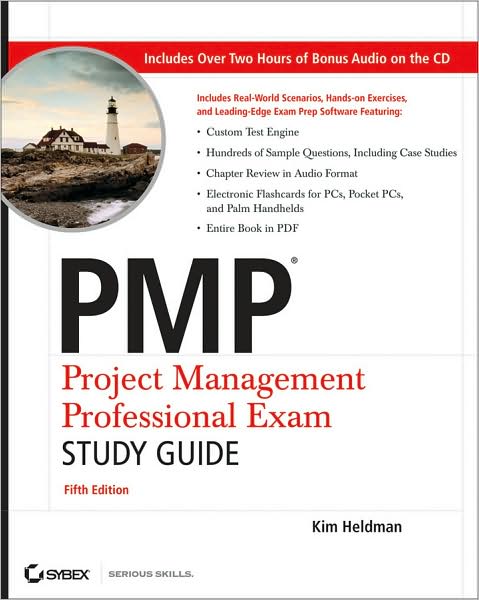 Written by project management expert Kim Heldman,
  On your project you handle known risks by performing the Plan Risk Responses process. Which of the following would you use when you encounter unknown risks?
 Here is what Kamen Kuntchef, PMP has to say about his PMP Exam success..