|
In this issue... |
 Hello , Hello ,
This week, we are featuring our Free PM PrepCast which contains valuable free exam tools and resources that can help you prepare for your PMP® Exam.
Other helpful information on this week's issue include:
- The April 2012 discount coupon on The PM Formulas.
- Our recommended study material: PMP: Project Management Professional Exam Study Guide by Kim Heldman, PMP
- Featured Article of the Week: The 4 Secret Ingredients to Passing the PMP Exam
- Three Ways To Prepare For Your PMP Exam as the featured video of the week
- PMP Exam Sample Question and Answer.
- PMP Exam Tip: Answer all PMP Exam questions from the PMBOK perspective
Read on and Enjoy!
Until Next Time,
Cornelius Fichtner, PMP
President, OSP International LLC |
| Get 7 Free PMP Exam Resources |
Preparing
to take and pass the PMP® Exam is an inten se, complex, and sometimes
even an expensive venture. So, why wouldn't you want access to a variety
of free exam resources located conveniently in one place? That is what
you can expect when you sign up for The Free PM PrepCast. se, complex, and sometimes
even an expensive venture. So, why wouldn't you want access to a variety
of free exam resources located conveniently in one place? That is what
you can expect when you sign up for The Free PM PrepCast.
Just go to http://www.pm-prepcast.com/free and sign up to receive all of these valuable free exam tools and resources in one convenient location:
- 75
minutes of free training from The PM PrepCast. Check out these four
sample videos and get introduced to the basics of the PMP exam, learn
about Project Integration Management and find out how to select the best
answer on sample questions.
- Five
PMP® Exam Worksheets and Checklists to help you best complete the PMP®
Exam application. The worksheets are designed to help you complete the
complex Experience Verification and Contact Hour sections of the online
PMP application.
- A
free eBook, The Short Guide to Becoming A PMP, which details the eight
steps to consider when preparing to take the PMP® Exam to ensure you
learn what you need to know in order to best prepare for the PMP® Exam.
- Over 15 PMP® Exam Tip videos covering such topics as "Manage the Time During Your PMP Exam," "Exam Time management and Question Styles," and "Assess Your PMP Exam Readiness with Free Sample Exams" to help you get ready for the PMP® Exam and exam day.
- 75
PMP® Exam eFlashCards that can be downloaded to a portable medial
player (iPod, iPhone, Blackberry, Treo, Smart Phone, etc.) for
convenient studying anytime and anywhere.
- Interviews
with successful PMPs that will provide you with insight from those who
have already passed the exam and are working in the project management
field.
With
all of the free resources available as part of The Free PM PrepCast
membership how could you afford to pass up the opportunity to simplify
your application process and take advantage of the many exam preparation
resources and tools?
In
addition to these priceless resources and tools mentioned will also
receive the weekly PMP Exam Tips Newsletter that will contain even more
free resources, tools, and tips to keep you on track in your effort to
pass the PMP® Exam.
You are only a moment away to access to these free and valuable resources. Go to http://www.pm-prepcast.com/free and sign up for your free account to get on your way to earning your PMP Certification. |
|
April 2012 Discount Coupon
|
For our next amazing deal and offer, we bring you a $9.97 discount coupon for The PM Formulas Instead of paying the regular price of $29.97, you can get The PM Formulas for just $20.00. This offer is good from April 1-30, 2012 only. Details are as follows:
Product: The PM Formulas
Regular price: $29.97
Discount: $9.97
Price after discount: $20.00
Coupon validity: April 1-30, 2012
Coupon code: Apr12
Redeeming this great deal is easy!
First watch this video here http://www.youtube.com/watch?v=8tG81gp6AuQ to learn how to use the coupon and then go to our website at http://www.pmformulas.com/ where you begin by clicking on "Order" at the top. (Please note that our coupons are only available for new purchases and cannot be applied as a refund if you purchased earlier.)
Sign up for our free newsletter to get the latest coupon codes, amazing deals and promos for our featured products each month! Our coupon codes can also be found on our websites so look out for them and don't let the opportunity pass you by.
Order now as this is only a one time limited offer that you cannot get anywhere else! |
| Recommended Study Material: PMP: Project Management Professional Exam Study Guide by Kim Heldman, PMP |
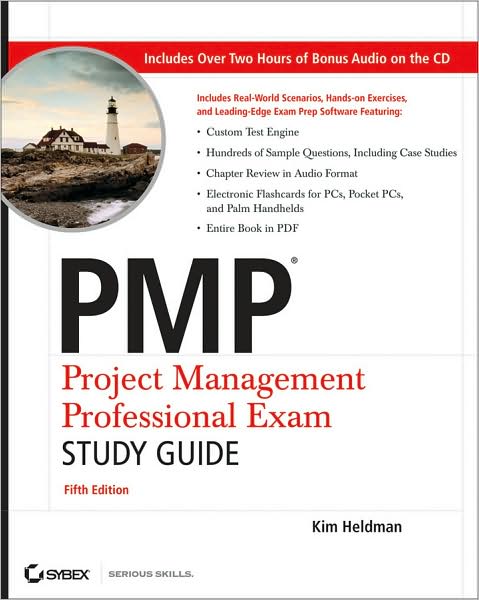 Written by project management expert Kim Heldman, PMP: Project Management Professional Exam Study Guide (Disclosure: Compensated Affiliate) is an excellent book that will guide project managers on their way to the PMP Exam. It provides comprehensive coverage of the exam objectives, essential PMP topics, concepts, and key terms. Written by project management expert Kim Heldman, PMP: Project Management Professional Exam Study Guide (Disclosure: Compensated Affiliate) is an excellent book that will guide project managers on their way to the PMP Exam. It provides comprehensive coverage of the exam objectives, essential PMP topics, concepts, and key terms.
Your benefits are:
- Prepare you to take the PMP Exam and the CAPM Exam both offered by PMI. It covers all essential procedures and concepts from PMBOK Guide, 4th Edition.
- Uses real-world scenarios and How This Applies to Your Current Project sidebars to fully illustrate concepts.
- Includes CD with testing software, practice exams, electronic flashcards, and over two hours of audio review.
- Serves as a valuable go-to book to keep on hand -- even after the exam.
Project managers who took the exam noted how PMP: Project Management Professional Exam Study Guide is exceptional in teaching useful information that consistently appeared on the test.
For more information and customer reviews, click here!
Full Disclosure: PMP: Project Management Professional Exam Study Guide is an affiliate product. If you click and choose to purchase the book, we will earn a commission.
|
|
| The 4 Secret Ingredients to Passing the PMP Exam |
The Project Management Professional (PMP) exam is developed and administered by the Project Management Institute (PMI) to measure and assess an individual's ability to apply project m
anagement skills in six different domains. Initiation, planning, execution, monitoring and controlling, closing the project, as well as professional and social responsibility are evaluated. Don't be intimidated! While the material may seem overwhelming, there are a few important factors to consider when preparing to successfully earn your PMP certificate. Experience, understanding of project management principles, developing a solid study plan and reliably
sticking to it, as well as practicing exam-taking strategies are essential ingredients for PMP exam success. Management Professional (PMP) exam is developed and administered by the Project Management Institute (PMI) to measure and assess an individual's ability to apply project m
anagement skills in six different domains. Initiation, planning, execution, monitoring and controlling, closing the project, as well as professional and social responsibility are evaluated. Don't be intimidated! While the material may seem overwhelming, there are a few important factors to consider when preparing to successfully earn your PMP certificate. Experience, understanding of project management principles, developing a solid study plan and reliably
sticking to it, as well as practicing exam-taking strategies are essential ingredients for PMP exam success. Secret Ingredient #1: Project Management Experience
Perhaps one of the most solid foundations for successful completion of the PMP exam is actual project management experience. Learning on-the-job with specific situations that develop a wide array of project management skills is an excellent way to retain information and far superior to rote memorization or passive reading. PMP test takers with project management experience are able to draw upon a database of information that is relevant and often easier to retrieve due to its personal nature. Recalling the small details of that last-minute project at work that your supervisor needed yesterday makes all of those grueling hours a worthwhile investment.
Before applying to take the PMP exam, PMI certification requires at least 4500 hours of experience in project management and 35 hours of documented training. This ensures that test-takers have the required skills to be successful and maintains the credibility of the certification.
Secret Ingredient #2: Understanding of Project Management Principles
Specific principles addressed in the PMP exam include communication, cost management, human resources, integration, procurement, quality, risk, scope, and time management. Each of these topics is covered in A Guide to the Project Management Body of Knowledge (PMBOK® Guide). You must understand them individually and how they work together to ensure overall successful project management. It is essential to use the most current version of the PMBOK® Guide for studying and review.
Secret Ingredient #3: Having a solid plan to study for the exam & sticking to it
As with all standardized examinations, the PMP covers a wide variety of material in a relatively short period of time. Don't be discouraged! Remember that careful planning and structure are essential to your exam success. It is important to develop a PMP Exam Study Plan to reduce the amount of intimidating material into manageable portions. People often find they work well with a structured exam preparation course that provides focused instruction over a specific timeline. One of the requirements of the PMP examination (35 hours of project management instruction) can be met with an online or in-person class. If you select an online course, ensure the class provides an "end of course assessment" and gives you written certification of participation and completion of required instruction hours.
The number ant type of questions on the exam are: initiating the project (11%), planning the project (23%), executing the project (27%), monitoring and controlling the project (21%), closing the project (9%), and professional and social responsibility (9%). Many people often divide up their study time in a similar manner, giving more hours to those topics that are tested more heavily. Others take practice exams and note specific weak areas in their knowledge, choosing to focus more review time on those topics. Your plan of attack will be personal and best suited to your own strengths, weaknesses, and timeline.
Most resources recommend spending one to two hours each day for four to eight weeks in preparation. Some people will require more time and others will require less. Work out a schedule with a manageable amount of material to cover each day. Be realistic in how much can be covered in one to two hours so that the schedule can be followed closely and certain areas don't slip, get skipped, or left out completely. Remember that most of us can't afford to neglect our day job during this study period and still have external commitments and responsibilities. Set weekly goals and regularly take practice exams to chart your progress. It's also very important not to forget to take refreshing breaks to do something you enjoy.
Secret Ingredient #4: PMP Exam-Taking Strategy
The PMP exam is made up of 200 multiple choice questions conducted on a computer at a Prometric testing center during normal business hours from Monday to Saturday. Test-takers are given a 15-minute tutorial and four hours to complete the exam. 25 pre-test questions remain ungraded, as they are used for future exam purposes. Inside the examination center, test takers are provided with rough sheets of paper and pencils. If needed, there are a variety of translation materials available upon request as the exam is only administered in English.
Mock questions and simulation exams are available from a variety of test preparation websites. Practice exams help future test-takers become familiar with the style and format of questions and enhance the endurance required for four-hour exams. It is commonly recommended that consistently scoring above 80% on mock exams is a strong indicator of success on the real thing. Gauge your progress on a weekly basis and determine how comfortable you feel with each topic area. Arriving on exam day with confidence means half the battle is already won.
Specific tips for test day strategies include sleeping well the night before, eating a healthy breakfast, wearing comfortable clothing, and arriving early. Before beginning the exam, many test-takers like to utilize the provided rough sheet to write out things like formulae, lists of processes with their inputs and outputs, as well as tools and techniques that will be useful throughout the exam. Consider taking two breaks spaced evenly throughout the exam. Don't waste too much time on a single question; mark it for review and move on.
Applying these four simple steps thoroughly and intelligently will ensure that the valuable time and money spent on the PMP exam is not wasted. Successful completion of the PMP depends on a test-takers ability to put their project management experience to work, to understand and apply project management principle, to thoroughly prepare with a solid study plan, and to bring everything smoothly together on a stressful exam day. Preparation is the key to reducing stress and guaranteeing success. |
Three Ways To Prepare For Your PMP Exam
|
Once you have set the career goal of taking the Project Management Professional (PMP) exam you have to decide on your study approach.
Your choice will depend on how much self-motivation you have, the schedule you set and (of course) your budget. This video explores the three options that lie before you.
|
|
| Sample PMP Exam Question |
 A custom jewelry manufacturing company took up a project to design and manufacture a necklace for an affluent personality. While in execution, during a metrics analysis meeting, the project team started to analyze the reasons for variations in the project's key performance metrics. The concern was the cost of quality that had been increasing for the past seven weeks. The first milestone (design of the necklace) is supposed to be delivered in another two days and the project manager is not comfortable with the trend. The team performed an analysis and identified that most of the defects seen surfaced during the requirements phase. Despite the deficiencies that surfaced during the requirements phase, the design activity was still started. Though the tasks were clearly defined with objectives, the business analyst had been released with a good performance rating. There was no way the details on requirements could be gathered except from the requirements document, which was not complete. A custom jewelry manufacturing company took up a project to design and manufacture a necklace for an affluent personality. While in execution, during a metrics analysis meeting, the project team started to analyze the reasons for variations in the project's key performance metrics. The concern was the cost of quality that had been increasing for the past seven weeks. The first milestone (design of the necklace) is supposed to be delivered in another two days and the project manager is not comfortable with the trend. The team performed an analysis and identified that most of the defects seen surfaced during the requirements phase. Despite the deficiencies that surfaced during the requirements phase, the design activity was still started. Though the tasks were clearly defined with objectives, the business analyst had been released with a good performance rating. There was no way the details on requirements could be gathered except from the requirements document, which was not complete.
Which of the following failed in the above scenario?
A.) Setting expectations and team performance assessment
B.) Setting expectations but not team performance assessment
C.) Only team performance assessment
D.) WBS decomposition
Hint: The teams assessment was not performed properly
All our questions are updated to the latest PMBOK Guide standard. Stop by at http://free.pm-exam-simulator.com and try the PMP Exam Simulator free for 3 days. We also offer 110 free questions at http://www.free-pm-exam-questions.com. We are a PMI Registered Education Provider.
|
|
|
Exam Tip:Answer all PMP Exam questions from the PMBOK perspective |
The PMP certification examination is a computer-based exam that is offered at testing centers worldwide. The exam is based on much of the information contained in A Guide to the Project Management Body of Knowledge (PMBOK Guide).
The questions in the PMP Exam are based on the following process groups from the PMBOK Guide: Initiating, Planning, Executing, Controlling, Closing and Professional Responsibility. So expect questions like: Which process is applied to break down the project into smaller, more manageable elements?, or: Which Tools and Techniques are part of Risk Management Planning? Some questions use project management terms that may be interchangeable with others. There will be a few questions that require you to perform simple math calculations. Or you will be required to interpret graphs or diagrams on some questions.
The number one statement to remember is that you need to answer all questions on the exam from the perspective of the PMBOK Guide, even if you feel that this question is one of those that are not 100% aligned with the standard. Asking yourself "What would the PMBOK do?" is a good place to start.
Remember that PMI is trying to present an ideal environment for project managers that might be different from your own experience. The PMBOK Guide will help you a lot here simply because it gives the right answers to all the questions that you will encounter during the exams. Or it will at least point you in the right direction. So if you really want to be prepared for your exams, read your PMBOK Guide extensively and understand the lessons here.
|
|
Answer and Explanation
|
The correct answer is C
Explanation: Setting expectations did not fail as the scenario clearly indicates that the tasks and objectives were defined and the WBS decomposition is clearly not at fault either.
The correct choice is C as team performance assessment is measured in terms of timely completion of tasks, success on agreed objectives and results that are achieved by the team members. Since the team performance assessment was not done for the business analyst, the rating was give as good even though his task were not completed. More over this ignorance by the project manager has impacted the whole teams performance.
Reference: PMBOK4 - pg: 235, Section 9.3.3.1
|
|
Lessons Learned from Jill Polanycia, PMP
|
 I passed the PMP exam on April 7th, after 10 long, grueling months. Here is what I did to prepare: I passed the PMP exam on April 7th, after 10 long, grueling months. Here is what I did to prepare:
1. Of course I read the PMBOK, plus Rita Mulcahy's book, as well as took the SkillSoft 1-2-hour sessions that followed the PMBOK guide quite well. Rita's book and the SkillSoft sessions were provided to me by my company, and if I had to choose one over another, I'd choose Rita's book because it really provided a different perspective.
2. I signed up for the PMP Exam Simulator and probably went through 90% of the 1,800 questions in there! On weekends I was doing a full 4-hour exam, and during the week, in whatever time I had, I was doing quizzes of varying lengths. I found the simulator to be extremely beneficial, not only for the wide variety of questions that are very similar to those on the exam, but also to be able to time myself. I was always ending the exam simulations early, but also knew that there were questions I was still getting wrong because I was reading through them too quickly. At the actual exam I took the full 4 hours, to read the questions much more slowly, and I think that allowed me to get many questions correct that I'd otherwise get wrong.
The PMP Exam Simulator also allowed me to detect trends in the types of questions I was getting wrong, and why. I actually went through the results every time and categorized the wrong questions into several groupings: I misread the question, had no idea what the answer was, got the ITTO's confused, etc. This categorization then told me what I needed to study more.
I would definitely recommend the PMP Exam Simulator to anyone taking the PMP, I think the ability to simulate the real exam is absolutely essential, and is not something that is available for most professional certifications!
--Jill
How about you? Did you recently pass the PMP exam? Care to share your experience?
Simply click the "new thread" button here: http://bit.ly/9clxBE to let us know. |
|
|
|
