| In this issue... |
 Hello , Hello ,
The Short Guide to Becoming a PMP by Cornelius Fichtner, PMP, is now available for download. Read on to learn more.
Also, this week's issue include:
-
The August 2012 discount coupon on The PM Prepcast
-
Our recommended study material: PMP: Project Management Professional Exam Study Guide
-
Release and impact of The PMBOK Guide 5th Edition in 2012 as our featured video of the week.
- Article of the week: 7 Lessons Learned from the PMP Exam
-
PMP exam sample question and answer.
-
PMP exam tip: The Project Schedule
Read on and Enjoy!
Until Next Time,
Cornelius Fichtner, PMP
President, OSP International LLC
|
| August 2012 Discount Coupon |
For our next amazing deal and offer, we bring you a $20 discount coupon for The PM Prepcast. Instead of paying the regular price of $129.99, you can get The PDU Podcast for just $109.99. This offer is good from August 1-31, 2012 only. Details are as follows:
Product: The PM Prepcast Regular price: $129.99
Discount: $20.00
Regular price: $129.99
Discount: $20.00
Price after discount: $109.99
Coupon validity: August 1-31, 2012
Coupon code: Aug12
Redeeming this great deal is easy! First watch this video here http://www.youtube.com/watch?v=8tG81gp6AuQ to learn how to use the coupon and then go to our website at www.project-management-prepcast.com where you begin by clicking on "Order" at the top. (Please note that our coupons are only available for new purchases and cannot be applied as a refund if you purchased earlier.)
Sign up for our free newsletter to get the latest coupon codes, amazing deals and promos for our featured products each month! Our coupon codes can also be found on our websites so look out for them and don't let the opportunity pass you by.
Order now as this is only a one time limited offer that you cannot get anywhere else!
|
| Recommended Study Material: PMP: Project Management Professional Exam Study Guide |
|
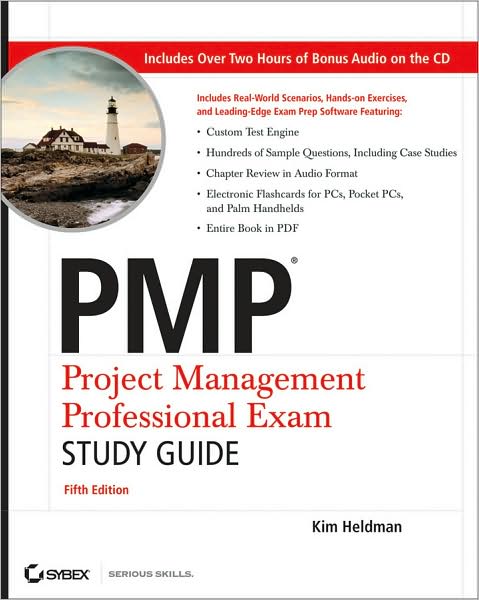 Written by project management expert Kim Heldman, PMP: Project Management Professional Exam Study Guide (Disclosure: Compensated Affiliate) is an excellent book that will guide project managers on their way to the PMP Exam. It provides comprehensive coverage of the exam objectives, essential PMP topics, concepts, and key terms. Written by project management expert Kim Heldman, PMP: Project Management Professional Exam Study Guide (Disclosure: Compensated Affiliate) is an excellent book that will guide project managers on their way to the PMP Exam. It provides comprehensive coverage of the exam objectives, essential PMP topics, concepts, and key terms.
Your benefits are:
-
Prepare you to take the PMP Exam and the CAPM Exam both offered by PMI. It covers all essential procedures and concepts from PMBOK Guide, 4th Edition.
-
Uses real-world scenarios and How This Applies to Your Current Project sidebars to fully illustrate concepts.
-
Includes CD with testing software, practice exams, electronic flashcards, and over two hours of audio review.
-
Serves as a valuable go-to book to keep on hand -- even after the exam.
Project managers who took the exam noted how PMP: Project Management Professional Exam Study Guide is exceptional in teaching useful information that consistently appeared on the test.
For more information and customer reviews, click here!
Full Disclosure: PMP: Project Management Professional Exam Study Guide is an affiliate product. If you click and choose to purchase the book, we will earn a commission. |
Congratulations!
|
Our warmest congratulations go to the following students of ours who have recently passed their PMP Exam:
- Srinivas Vanka, PMP

-
Sanjiv Kumar Malik, PMP
-
Zachary Schulz, PMP
-
Sunil Pandey, PMP
-
Chiteka Jackson, PMP
Have you passed your exam as well? Then let us know by writing to examtips@pm-prepcast.com
|
7 Lessons Learned from the PMP Exam
|
Everyone has different ways of studying for the PMP certification. You may carry the PMBOK Guide around with you, or use flashcards. You may join your local Project Management Institute (PMI) Chapter and study in a group. Whatever your study path, someone has been there before you.
While everyone has a slightly different story to tell, there are some things that make a big difference to your chances of success with the PMP Exam. Luckily, exam candidates are very happy to share their stories and lessons learned with you. We have reviewed and analyzed a number of lessons learned from the PMP Exam that successful exam takers have posted on our website. Here are our top 7 lessons learned.
1: Make a plan
"I had a plan laid out and had to rebaseline it twice but it helps to view where you are and align it once every 2-3 days," says one student on our forum. Create a plan in a format that works for you and stick to it. It's OK if it changes every so often, but having a plan will allow you to assess if you are on track with your studies. And you can take corrective action if you ar`e not.
2: Read the PMBOK Guide
You might think this is obvious, but it really does help to have a copy of the PMBOK Guide. "Get a copy of the current edition and read it twice," recommends one successful student. "The first time highlight the important parts and the second time make flashcards of those highlights. Doing the flash cards will help get the information into your head." You can then go through your flashcards daily to remind yourself of the key points in the PMBOK Guide. "It is also a good reference," the new PMP adds. "Go through the glossary twice... you will notice a few interesting definitions like Elapsed Time and Duration."
The PMBOK Guide is the basis for the majority of the questions in the exam, so you really do have to know the concepts and the terminology thoroughly.
3: Take sample exams
Several successful students recommend taking full PMP exams. "The use of full exams besides learning is to get to a discipline in taking the 4 hour exam," one explains. "If you build on your mistakes, analyze why you are wrong, the final exam will be much easier. I also advise you to mark those answers which you guess, as next time you may guess wrong!"
Note what you got wrong in your sample exams. "You should try to understand why you answered incorrectly," recommends another successful candidate. "I made a list of some categories such as 'ITTO knowledge', 'Concept not understood', 'Question misunderstood'."
Taking sample exams will help you establish where you need to concentrate your remaining study hours by flagging up the areas that you don't fully understand.
4: Make the most of your study time
One exam taker explains how they found extra hours in the day to study. "Commuting to my work and back takes 2-3 hours so I decided to utilize this time effectively by listening to The PM PrepCast."
Find moments in your day where you can study. "If you have an iPhone download an app that will allow you to practice all your ITTO's," recommends a student. "It will make it fun to practice."
Passing the PMP exam successfully requires a lot of study - more than perhaps you first thought. Seek out extra time in the day where you can revise concepts to boost your study hours.
5: Be confident
"Trust yourself," advises one new PMP. "If you can score around 75-80% in an exam simulator, you can feel confident about passing the exam." Building your confidence is a key strategy to successfully passing the exam. You want to enter the exam room knowing you have the skills and knowledge to pass the PMP Exam. It will make you feel better about the exam itself, especially if you have not taken an exam for some time.
6: Time yourself
Four hours may seem like a long time but PMP certification holders know that it goes quickly. "Plan on your exam time expanding during the real exam," suggests one student. "I had been taking practice exams in about 2.5 hours. On the day of the exam, I had under 3 minutes left on my timer when I hit submit. I spent much more time analyzing questions than I had before."
You don't want to run out of time in the exam so make sure you know what 4 hours feels like. Check you can get though a complete sample exam in that time.
7: Listen to others
Yes, lessons learned are a great way to prepare! Talk to previous students, discuss your study plans with members of your local PMI Chapter and listen to as many people talking about their own journey to becoming a PMP as you can.
One successful student on our forums recommends listening to interviews through podcasts. "People are asked about their experiences during their preparations and the exam itself," the new PMP says. "Listening to the different opinions and experiences motivated me a lot. At the beginning of your study time you get an understanding of the effort it takes to pass the PMP Exam." Talking and listening to others will help you establish if your study plans are on track.
|
|
Release and impact of The PMBOK Guide 5th Edition in 2012
|
|
|
In this video we are going to review when the  PMBOK Guide 5th Edition will MOST LIKELY be released, what this means for the PMP Exam and what version of study materials you should be using for the exam. PMBOK Guide 5th Edition will MOST LIKELY be released, what this means for the PMP Exam and what version of study materials you should be using for the exam.
|
| Sample PMP Exam Question |
|
During which phase of the project would you  suggest the integrated change control process?What is the best way to finish a formal customer presentation that will promote effective communication? suggest the integrated change control process?What is the best way to finish a formal customer presentation that will promote effective communication?
A.) Taking minutes of the meeting.
B.) Offering the customer a cup of coffee.
C.) Asking the customer if they have any questions.
D.) Summarizing and recapping.
Hint: Answer the question from the best method of communication perspective.
Please click here to give your answer and see the explanation...
|
|
Exam Tip: The Project Schedule
|
In project management, a schedule consists of a list of a project's tasks with intended start and finish dates. Tasks are the lowest element in a schedule; they are not further subdivided. Those items are estimated in terms of resource requirements, budget and duration, linked by dependencies and scheduled. Project Scheduling helps identify all of the tasks that are required to complete a project on time. It adds dependencies between tasks so that if one task slips, the tasks related to it slip.
[On a side note: As we mentioned in last week's tip, in many organizations the terms "project management plan" and "project schedule" are often used interchangeably. If this is the case in your organization, then please make sure that you understand that for the PMP Exam, these are two distinctly different documents. Please refer back to last week's tip for the discussion of the project management plan.]
Before a project schedule can be created, a project manager will typically have a work breakdown structure (WBS), an effort estimate for each task, and a resource list with availability for each resource. If these are not yet available, it may be possible to create something that looks like a schedule, but it will essentially be a work of fiction. They can be created using various estimation methods. A good best practice is to include the people who will perform the actual work in the estimation process. The reason for this is that a schedule itself is an estimate: each date in the schedule is estimated, and if those dates do not have the buy-in of the people who are going to do the work, the schedule will be inaccurate.
In many industries, such as engineering and construction, the development and maintenance of the project schedule is the responsibility of a full time scheduler or team of schedulers, depending on the size of the project. And though the techniques of scheduling are well developed, they are inconsistently applied throughout industry. Standardization and promotion of scheduling best practices are being pursued by the Association for the Advancement of Cost Engineering (AACE), the Project Management Institute (PMI). In some large corporations, scheduling, as well as cost, estimating, and risk management are organized under the department of project controls.
The PMBOK Guide 4th Edtion says the following about the Project Schedule: As a minimum, the project schedule includes a planned start date and planned finish date for each activity. Develop Schedule is the process of analyzing activity sequences, durations, resource requirements, and schedule constraints to create the project schedule.
Read more about Project Schedule in the PMBOK Guide 4th Edition from 6.5.3 to 6.5.4
|
|
Download the Short Guide to Becoming a PMP
|
The Short Guide to Becoming a PMP by Cornelius Fichtner, PMP, is now available for download.
For project managers who are preparing to take the challenging PMP exam, here's a little help to get you started. The Short Guide to Becoming a PMP is a FREE e-book designed to help you prepare for and pass the exam with flying colors.
Written by noted PMP, Cornelius Fichtner, the e-book is based on Mr.
Fichtner's own PMP-exam experience, both as a student and instructor. So
learn from his real-world perspective as he passes on his knowledge and
expertise to you. He shares simple steps that will help you with the
following:
- Assess your eligibility
- Fill out the PMP application
- Create a PMP Study Plan
- Acquire essential study materials
- Develop techniques for studying
- Answer sample test questions
- Prepare for the examination day
The e-book is absolutely free. Get your copy now and pave the road for your PMP certification! Click here!
|
|
|
|
