| In this issue... |
 Hello , Hello , What's in store in this week's issue?
This week's issue include:
-
The August 2012 discount coupon on The PM Prepcast
-
Our recommended study material: PMP: Project Management Professional Exam Study Guide
-
Learn who are this week's new PMPs. Are you next?
- Article of the week: How to find the BEST answer
-
PMP exam sample question and answer.
-
PMP exam tip: Use FlashCards to Study The Facts
- Testimonial of the Week from Gerald Derflinger
Read on and Enjoy!
Until Next Time,
Cornelius Fichtner, PMP
President, OSP International LLC
|
| August 2012 Discount Coupon |
For our next amazing deal and offer, we bring you a $20 discount coupon for The PM Prepcast. Instead of paying the regular price of $129.99, you can get The PDU Podcast for just $109.99. This offer is good from August 1-31, 2012 only. Details are as follows:
Product: The PM Prepcast Regular price: $129.99
Discount: $20.00
Regular price: $129.99
Discount: $20.00
Price after discount: $109.99
Coupon validity: August 1-31, 2012
Coupon code: Aug12
Redeeming this great deal is easy! First watch this video here http://www.youtube.com/watch?v=8tG81gp6AuQ to learn how to use the coupon and then go to our website at www.project-management-prepcast.com where you begin by clicking on "Order" at the top. (Please note that our coupons are only available for new purchases and cannot be applied as a refund if you purchased earlier.)
Sign up for our free newsletter to get the latest coupon codes, amazing deals and promos for our featured products each month! Our coupon codes can also be found on our websites so look out for them and don't let the opportunity pass you by.
Order now as this is only a one time limited offer that you cannot get anywhere else!
|
| Recommended Study Material: PMP: Project Management Professional Exam Study Guide |
|
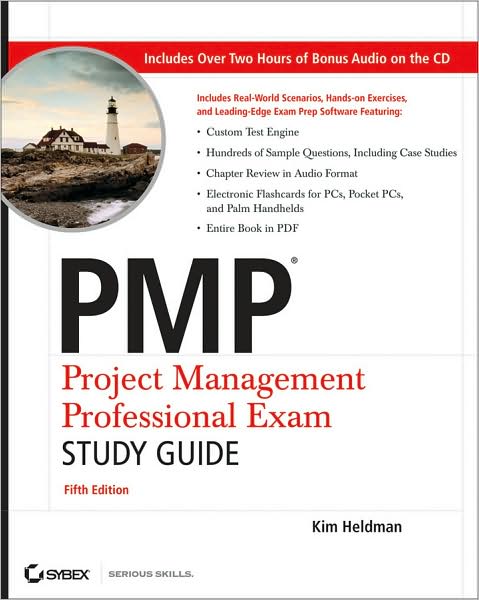 Written by project management expert Kim Heldman, PMP: Project Management Professional Exam Study Guide (Disclosure: Compensated Affiliate) is an excellent book that will guide project managers on their way to the PMP Exam. It provides comprehensive coverage of the exam objectives, essential PMP topics, concepts, and key terms. Written by project management expert Kim Heldman, PMP: Project Management Professional Exam Study Guide (Disclosure: Compensated Affiliate) is an excellent book that will guide project managers on their way to the PMP Exam. It provides comprehensive coverage of the exam objectives, essential PMP topics, concepts, and key terms.
Your benefits are:
-
Prepare you to take the PMP Exam and the CAPM Exam both offered by PMI. It covers all essential procedures and concepts from PMBOK Guide, 4th Edition.
-
Uses real-world scenarios and How This Applies to Your Current Project sidebars to fully illustrate concepts.
-
Includes CD with testing software, practice exams, electronic flashcards, and over two hours of audio review.
-
Serves as a valuable go-to book to keep on hand -- even after the exam.
Project managers who took the exam noted how PMP: Project Management Professional Exam Study Guide is exceptional in teaching useful information that consistently appeared on the test.
For more information and customer reviews, click here!
Full Disclosure: PMP: Project Management Professional Exam Study Guide is an affiliate product. If you click and choose to purchase the book, we will earn a commission. |
Congratulations!
|
Our warmest congratulations go to the following students of ours who have recently passed their PMP Exam:
 Kurt Hoenke, PMP Kurt Hoenke, PMP- Pranesh Biswas, PMP
- Chris Mellen, PMP
- Bindu Valapi, PMP
- Tania Donaldson, PMP
Have you passed your exam as well? Then let us know by writing to examtips@pm-prepcast.com
|
How to find the BEST answer
|
Quite often, project management is not totally black and white. A project manager can respond in various ways to events and situations as they arise over the course of a project. This means that when you have a personality conflict between two members on your team you have to decide how to handle that with the individuals and you have to decide how to handle that with the team. Do you deal with it head-on or would it be better to come up with a team-building exercise that may help your team to overcome the situation? Decisions like these are yours to make and since the dynamics of teams and each situation is unique you have to decide which one makes the most sense.
Sample PMP Exams mirror this situation. Quite often you will see a question with at least two right answers. With one valuable point towards your PMP certification on the line, you must select the best one. Let me repeat that: you must select the BEST one. Sometimes none of the answers may be 100% correct but one of them will be BETTER than the others if you're analyzing them correctly.
There is of course, no single, correct approach to analyzing the questions but there are several concepts and techniques that you should know.
Concept: The PMBOK Guide is always right -- The PMI strives to improve project management environments in such a way that in the future all projects will always be executed in the most ideal circumstances. This is the way the PMBOK Guide has been written and it is also the basis for which to answer the questions. Answer them from the perspective of the PMBOK Guide, not from your own experiences. When in doubt, the PMBOK Guide wins.
Concept: A Project Manager is proactive -- As a project manager you should never let a small problem linger to ensure it doesn't become a larger issue. When a problem is presented you should analyze it, define the various options that are available to you, and then select the response that best addresses the root cause. For our example above, the best answer would therefore be to address the personality conflict with the two team members directly and not try and solve it in a roundabout way by holding a team-building exercise.
Technique: Read the question completely first -- As obvious as this sounds, some people don't do it and end up missing important parts of the question. Start out by reading the question completely, make sure that you understand it, and that you can distinguish between the important facts and the extraneous information. Learn to ignore those facts that do not relate to the question. Then read all four possible answers; usually two of the four will be very obviously incorrect and can be eliminated. Finally, weigh the two remaining questions against each other and make your choice.
Technique: Use your brain -- Start out by reading the question but not the answers. Now close your eyes and think...what should the answer be? When you are ready, open your eyes again and read the answers. More often than not "your" answer will be there.
Technique: Start bottom up -- Read the answers first and then read the question. This upside down approach can be helpful in the case of very long questions.
Technique: Last sentence first -- Another useful technique for approaching long questions is to read the last sentence first. The last sentence usually contains the actual question. Now that you know what they really want to know, read the remaining text in this light. Also remember, you will have a checkbox that allows you to mark any questions you are uncertain of and want to come back and review later.
|
|
Release and impact of The PMBOK Guide 5th Edition in 2012
|
|
|
In this video we are going to review when the  PMBOK Guide 5th Edition will MOST LIKELY be released, what this means for the PMP Exam and what version of study materials you should be using for the exam. PMBOK Guide 5th Edition will MOST LIKELY be released, what this means for the PMP Exam and what version of study materials you should be using for the exam.
|
| Sample PMP Exam Question |
|
____________ is the total cost to produce the product or service of the project while meeting the quality standards plus the operating cost.
A.) Total Cost of Ownership
B.) Estimated Cost
C.) Cost of Quality
D.) Budgeted Cost
Hint: What is the total cost of a product?
Please click here to give your answer and see the explanation...
|
|
Exam Tip: Use FlashCards to Study The Facts
|
How do you create PMP Exam Flashcards? Here is what Wikipedia says: "A flashcard or flash card is a set of cards bearing information, as words or numbers, on either or both sides, used in classroom drills or in private study. One writes a question on a card and an answer overleaf. Flashcards can bear vocabulary, historical dates, formulas or any subject matter that can be learned via a question and answer format. Flashcards are widely used as a learning drill to aid memorization by way of spaced repetition."
For the PMP exam this means that you can use flash cards to study all the facts that you must memorize, like the names of the Knowledge Areas or processes from the PMBOK Guide. Or all the formulas you need. Or you can study the complete PMBOK Glossary using flashcards. Or any exam fact that you personally have trouble remembering.
How to create your cards: find the fact and write a question about this fact on the front of the card (i.e. What are the 5 Process Groups called in their correct order?) and then write the answer on the back (i.e. initiating, planning, executing, monitoring & controlling, closing). By doing this you achieve two goals: First of all you have to research these facts yourself and then write them down onto your card. This means that the act of creating the card itself is a learning experience. And second, now that you have this fact on your card you can review the question/answer on a daily basis. Repetition is the key.
http://www.project-management-flash-cards.com/
But of course, it's completely understandable that not everyone has the time and energy to create the cards for themselves and would prefer buying a set of cards. No problem. Various companies (ours included) have these ready made cards on sale. Some are paper based and some (like ours at www.pmflashcards.com) are electronic. The benefit of the electronic ones is that they are easy to carry around because they are loaded onto your phone. This means you can simply whip out your phone whenever you have five minutes available and work your way through a few cards. |
|
|
Testimonial of the Week |
" I used as a reliable preparation The PM PrepCast as well as The PM StudyCoach. My journey started almost a year ago, when I collected resources for the PMP examination. I started with both tools on the same time, so the StudyCoach was "my personal road to success" :-). The program has been very structured and I never had the feeling to loose the overall overview of my learning process. I also used my mobile device to listen to lessons when I drove to my office every day in the morning. Summarized I can really recommend both programs everyone who is preparing for the PMP exam." StudyCoach. My journey started almost a year ago, when I collected resources for the PMP examination. I started with both tools on the same time, so the StudyCoach was "my personal road to success" :-). The program has been very structured and I never had the feeling to loose the overall overview of my learning process. I also used my mobile device to listen to lessons when I drove to my office every day in the morning. Summarized I can really recommend both programs everyone who is preparing for the PMP exam."
- Gerald Derflinger
|
|
|
|
